
NATO M&S Support to Experimentation and Wargaming Pilot Course
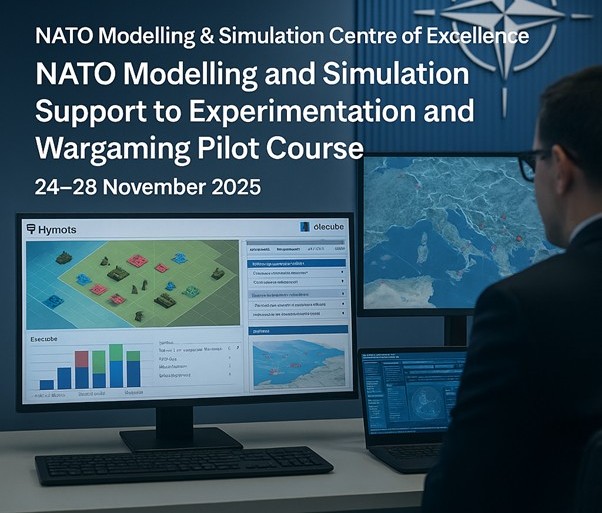
The NATO Modelling & Simulation Centre of Excellence (NATO MSCOE) is proud to announce the upcoming launch of the NATO Modelling and Simulation Support to Experimentation and Wargaming Pilot Course, which will take place from 24 to 28 November 2025, with the support of SIM4Future — an innovative start-up and officially recognized spin-off of the University of Genoa.
This pioneering initiative is designed to enhance NATO’s capabilities in operational experimentation, strategic foresight, and decision support, combining methodological depth with cutting-edge simulation and wargaming technologies. The course marks a decisive step forward in the integration of modelling and simulation into NATO’s educational and analytical ecosystem — where innovation becomes the bridge between knowledge and action.
This pilot course marks a significant step forward in the integration of advanced simulation and wargaming tools within the Alliance’s education and training framework. Built upon a cooperative effort between NATO MSCOE, academia, and industry, it represents the first course of its kind to combine methodological rigor with next-generation digital ecosystems for experimentation and analysis.
At its core, the course aims to provide NATO personnel and partner nations with a deep understanding of how modelling and simulation can enhance experimentation and wargaming processes — from concept development to operational evaluation. Participants will engage in a highly interactive learning experience, combining theory with practical exercises in realistic, data-driven environments.
Thanks to a strategic partnership with Ete Technology, the course will benefit from the integration of innovative platforms such as Hymots (Hybrid Multidomain Operations Tactics Strategy Simulation System) and Etecube (System for Education, Training, Exercise, Experimentation, and Evaluation).
Hymots is a constructive, continuous, interactive, stochastic, and dynamic simulation environment capable of replicating the full complexity of multidomain operations — land, maritime, air, space, cyberspace, and social domains. It enables the simulation of hybrid warfare, kinetic conflicts, and complex crises, whether human-made or natural. Through Hymots, participants will experience immersive wargaming scenarios at the strategic, operational, and tactical levels, encouraging analytical thinking and multidomain situational awareness.
Complementing this capability, Etecube provides an integrated framework for planning, conducting, and managing education, training, exercise, experimentation, and evaluation activities. During the pilot course, selected modules such as the Objective Management Module (OMM) and the Experiment Management Module (EMM) will be employed to guide participants through structured learning objectives and experimental designs. In cooperation with Ete Technology, additional modules — including the Setting/Scenario Management Module (SMM) — will support the construction and adaptation of complex simulation environments.
The course will also incorporate a range of established NATO and industry wargaming systems to ensure a comprehensive and comparative learning approach. Among these, the Joint Theater Level Simulation (JTLS- GO) will serve as a reference tool for operational-level simulation, enabling joint and combined exercises across multiple domains.
In addition, participants will engage with Sea-Salt A2/AD (Synthetic Environment for AI-based Wargame Simulation Across Multi-Layered Theatres and New Strategies – Anti-Access/Area Denial), a multidomain wargame developed by SIM4Future. In this innovative simulation, players manage entities across a multidomain chessboard — land, air, sea, cyber, and space — while facing evolving information environments that emulate real-world broadcasting, press, and social media dynamics (BPSM). The objective is to secure control of strategic areas and resources while anticipating adversarial actions and navigating cognitive and informational challenges.
The NATO MS Support to Experimentation and Wargaming Pilot Course embodies NATO MSCOE’s commitment to innovation, interoperability, and excellence in education and training. By combining methodological foundations, technological innovation, and multidomain integration, the course paves the way for a new generation of NATO professionals capable of thinking and acting across the full spectrum of operations.
This initiative not only strengthens NATO’s experimentation ecosystem but also showcases the value of collaboration between NATO institutions, industry leaders, and academic partners in shaping the future of defence analysis and decision-making.
Written by Cdr Dino D. Tropea NATO M&S COE
For further details and information, click on:
M&S Courses and Training Activities
+++++++++++++
The NATO Modelling & Simulation Centre of Excellence is dedicated to the promotion of Modelling & Simulation in support of operational requirements, training and interoperability. The Centre act as a catalyst for transformation through the involvement of NATO, governments, academia, industry, operational and training entities, by improving the networking of NATO and nationally owned Modelling & Simulation systems, the cooperation between Nations and organizations through the sharing of Modelling & Simulation information and developments and serving as an international source of expertise for transformation in the related domain. https://www.mscoe.org
NATO Centres of Excellence are nationally or multi-nationally funded institutions accredited by NATO. They train and educate leaders and specialists from NATO member and partner countries, assist in doctrine development, identify lessons learned, improve interoperability and capabilities, and test and validate concepts through experimentation. They offer recognized expertise and experience that is of benefit to the Alliance and support the transformation of NATO, while avoiding the duplication of assets, resources and capabilities already present within the NATO command structure. Although not part of the NATO command structure, they are part of a wider framework supporting NATO Command Arrangements. [source https://www.act.nato.int/centres-of-excellence]
 NATO
NATO